top of page
PUBLICATION


MULTIMEDIA INSIGHT

20:53
Who Regulates the Machine? The Global AI Law Imperative | AI Governance & Regulation
Artificial intelligence is moving rapidly from a tool that assists humans to systems capable of generating content, making recommendations, operating autonomously and influencing decisions with real-world consequences. But who is legally responsible when AI causes harm, produces fabricated information, generates synthetic evidence or acts with limited human intervention? In this episode, Ambat Legal Insight examines the emerging global AI law landscape, including the European Union, China, the United Kingdom, the United States and India. We explore AI hallucinations, deepfakes, synthetic evidence, autonomous AI agents, human oversight, liability and the growing question of whether existing laws are sufficient. The discussion concludes with a practical India-focused approach to AI governance and the possibility of a future legal framework built around risk, accountability, transparency and meaningful human control.
To read the above article, please click the below link:
https://www.ambatlegalinsight.com/post/ai-law-imperative-global-regulation-artificial-intelligence
#AILaw, #AIRegulation, #AIGovernance, #ArtificialIntelligence, #AIandLaw, #FutureOfLaw, #LegalTechnology, #AILawIndia, #AIRegulationIndia, #IndianLaw, #AIAccountability, #AIAct, #Deepfakes, #SyntheticEvidence, #AIAgents, #AutonomousAI, #DigitalEvidence, #LegalTech, #InternationalLaw, #AmbatLegalInsight
24:40
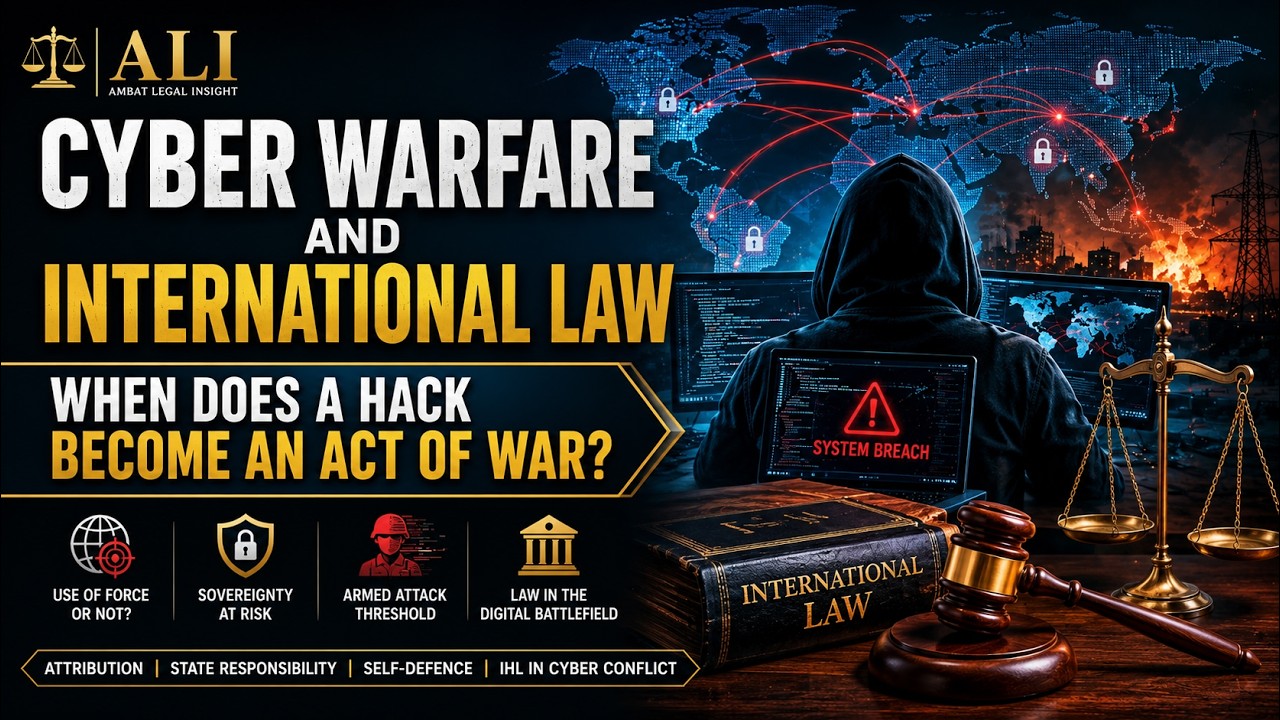
Cyber Warfare and International Law: When Does a Hack Become an Act of War?
When does a cyberattack become an act of war?
A cyber operation can shut down a power grid, cripple communications, disrupt financial systems, steal military secrets or even cause physical destruction—without a single missile being fired. But under international law, does that automatically make it an armed attack?
In this episode of Ambat Legal Insight (ALI), we examine the difficult legal boundary between cybercrime, cyber espionage, cyberattacks, unlawful intervention, use of force and an armed attack under international law.
We explore Article 2(4) and Article 51 of the UN Charter, State responsibility, attribution, sovereignty, non-intervention, self-defence and international humanitarian law, and examine how existing international law is being applied to the rapidly evolving domain of cyber warfare.
We also examine the issue from an Indian strategic and legal perspective, asking what India needs to consider when confronting State-sponsored cyber operations against critical infrastructure, defence systems and national institutions.
The central question is simple:
When does a hack stop being a hack—and become an act of war?
This is Ambat Legal Insight—where law meets emerging technology, national security and the future of State power.
#CyberWarfare, #CyberLaw, #InternationalLaw, #CyberAttack, #CyberSecurity, #CyberConflict, #ActOfWar, #ArmedAttack, #UseOfForce, #UNCharter, #Article51, #StateResponsibility, #CyberEspionage, #CyberOperations, #InternationalHumanitarianLaw, #LawOfWar, #Cyberwar, #CyberSecurityLaw, #India, #IndianCyberSecurity, #AmbatLegalInsight, #ALI, #AmbatMediaGroup

21:42
When AI Writes the Law: Can Indian Courts Trust Artificial Intelligence?
Artificial intelligence is rapidly entering the legal profession—but what happens when AI invents a judgment that never existed?
In July 2026, the Supreme Court of India confronted exactly this problem in Pooja Ramesh Singh v. Jammu and Kashmir Bank Ltd., 2026 INSC 668. The Court found that the NCLT and NCLAT proceedings had relied upon fake, non-existent and AI-hallucinated legal precedents and set aside the decisions. More importantly, the Supreme Court made it clear that AI may assist adjudication, but human beings must retain control over the judicial process.
In this episode of Ambat Legal Insight, we explore what this landmark development means for lawyers, judges, legal research, professional ethics, digital evidence, judicial independence and the future of justice.
Can lawyers trust AI-generated legal research? Should AI use be disclosed in court? Who is responsible when an AI-generated citation enters a judgment? And could artificial intelligence ever become more than an assistant to a judge?
The future courtroom may contain artificial intelligence—but who should remain in charge?
Read the complete analysis- https://www.ambatlegalinsight.com/post/ai-in-indian-courts-can-judges-lawyers-trust-artificial-intelligence
#AIAndLaw, #AIInIndianCourts, #ArtificialIntelligence, #LegalTechnology, #AILawIndia, #IndianJudiciary, #SupremeCourtOfIndia, #LegalEthics, #AIHallucination, #JudicialAI, #FutureOfLaw, #DigitalEvidence, #LawAndTechnology, #AmbatLegalInsight, #ALI,

22:08
Who Owns Your Digital Twin? The Next Legal Battle Over AI Identity | AI Law Explained
Artificial intelligence is no longer just generating content—it is beginning to replicate people. AI can now clone voices, recreate faces, imitate writing styles, and even build convincing digital versions of individuals. These "digital twins" promise enormous opportunities in education, business, healthcare, and entertainment. But they also raise one of the biggest legal questions of the AI era:
Who actually owns your digital twin?
In this episode of Ambat Legal Insight, Advocate Manoj Ambat explores the emerging legal battlefield surrounding AI identity. We examine digital personality rights, consent, privacy, intellectual property, deepfakes, biometric data, inheritance of AI identities, and why governments around the world—including India—must rethink existing legal frameworks before technology outpaces the law.
Whether you're a lawyer, policymaker, technology enthusiast, entrepreneur, student, or simply curious about the future of artificial intelligence, this episode provides a comprehensive legal perspective on one of the most important questions of the coming decade.
Visit:
https://www.ambatlegalinsight.com
#AILaw #ArtificialIntelligence #DigitalTwin #CyberLaw #Privacy #Deepfake #LegalTech #AILegislation #DigitalIdentity #AmbatLegalInsight
AI law, artificial intelligence law, digital twin, AI identity, digital identity, cyber law, legal podcast, privacy law, biometric privacy, AI regulation, AI governance, deepfake law, personality rights, right of publicity, intellectual property, AI ethics, generative AI, consent, digital rights, technology law, advocate Manoj Ambat, Ambat Legal Insight, future of law, AI policy, AI legislation
Explore Legal Insights
Our mission is to strengthen informed public participation by delivering clear, factual, and accessible legal and policy analysis — free from political bias or sensationalism.


Law, Policy & Public Thought
Explore evidence-based commentary on law, governance, and public policy. New articles will be added as our research grows.

Videos & Webinars
Our video series features policy explainers, expert interviews, webinars, and event highlights — designed to make complex legal and governance issues understandable for researchers, professionals, students, and the public. Watch factual content without sensationalism or political bias.

Policy Matters Podcast
Conversations with legal and public-policy thinkers. Episodes will be released here as we launch our podcast series.
bottom of page